Showing posts with label puff pastry. Show all posts

Thursday, September 27, 2012

Curry Puffs

There's a Thai restaurant near my office called Rhong-Tiam. Their food is really good and they even use organic chicken and grass-fed, hormone-free beef. Plus they deliver! So every once in a while I indulge and have their curry puffs for lunch. They're so delicious, I like to get an extra order and bring them home to heat up the next day. Now don't get too excited, because this isn't their recipe. I just made this one up in an attempt to recreate something similar (only my version is vegetarian). I can't claim mine rival Rhong-Tiam's, but I liked them a lot and if I didn't live or work anywhere near Rhong-Tiam, I'd totally make them again (of course I don't have to, so I'll probably just pick up the phone and dial).


CURRY PUFFS
Yield: 18

1 large Yukon Gold potato (or 2 small)
2 tablespoons vegetable oil
1 red onion, finely chopped
1 1/2 teaspoons finely grated fresh ginger
1 clove garlic, pressed or finely minced
1 teaspoon curry powder
1/4 teaspoon chili powder
1/4 teaspoon turmeric
1/2 teaspoon sugar or palm sugar
1/8 teaspoon ground white pepper (or black pepper to taste)
1/4 teaspoon salt
1 tablespoon finely chopped cilantro
1 (17.3 oz.) package frozen puff pastry sheets, thawed
1 egg, beaten (optional)

1/2 cup unseasoned rice wine vinegar (optional, for dipping)


1.      Bring a small pot of water to a boil. Peel the potato and chop into large chunks. Boil until easily pierced with a fork (but not falling apart). Drain and rinse under cold water. Once cool enough to handle, dice and set aside.
2.      Heat oil in a large skillet. Saute the onion, stirring frequently, for about 10 minutes. Add the ginger and garlic and cook for 1 minute. Add the curry powder, chili powder and turmeric and cook for 1 more minute.
3.      Add the diced potato, sugar, pepper and salt and cook for another 5 minutes. Taste and add more salt if needed. Set aside to cool.
4.      Heat oven to 400º F.
5.      Roll the puff pastry dough to ¼-inch thickness. Using a round cookie cutter, cut the dough into 3-inch rounds.
6.      Place a tablespoon of filling in the center of each round. Fold the pastry over to form a half circle. Crimp the edges together with a fork.
7.      Brush lightly with egg wash (optional – it just makes the pastry shinier) and bake for 20 minutes or until golden brown.
8.      Serve puffs warm with rice wine vinegar for dipping (if desired).

raw red onions
adding garlic and ginger to cooked red onions
adding spices
spices mixed in
adding potatoes, sugar, salt and pepper
filling mixed
cutting rounds from rolled dough
filling on dough
folding over & sealing dough
crimping with a fork
brushing with egg
raw curry puffs
baked curry puffs
more baked curry puffs, without
egg wash (you can see they're duller)
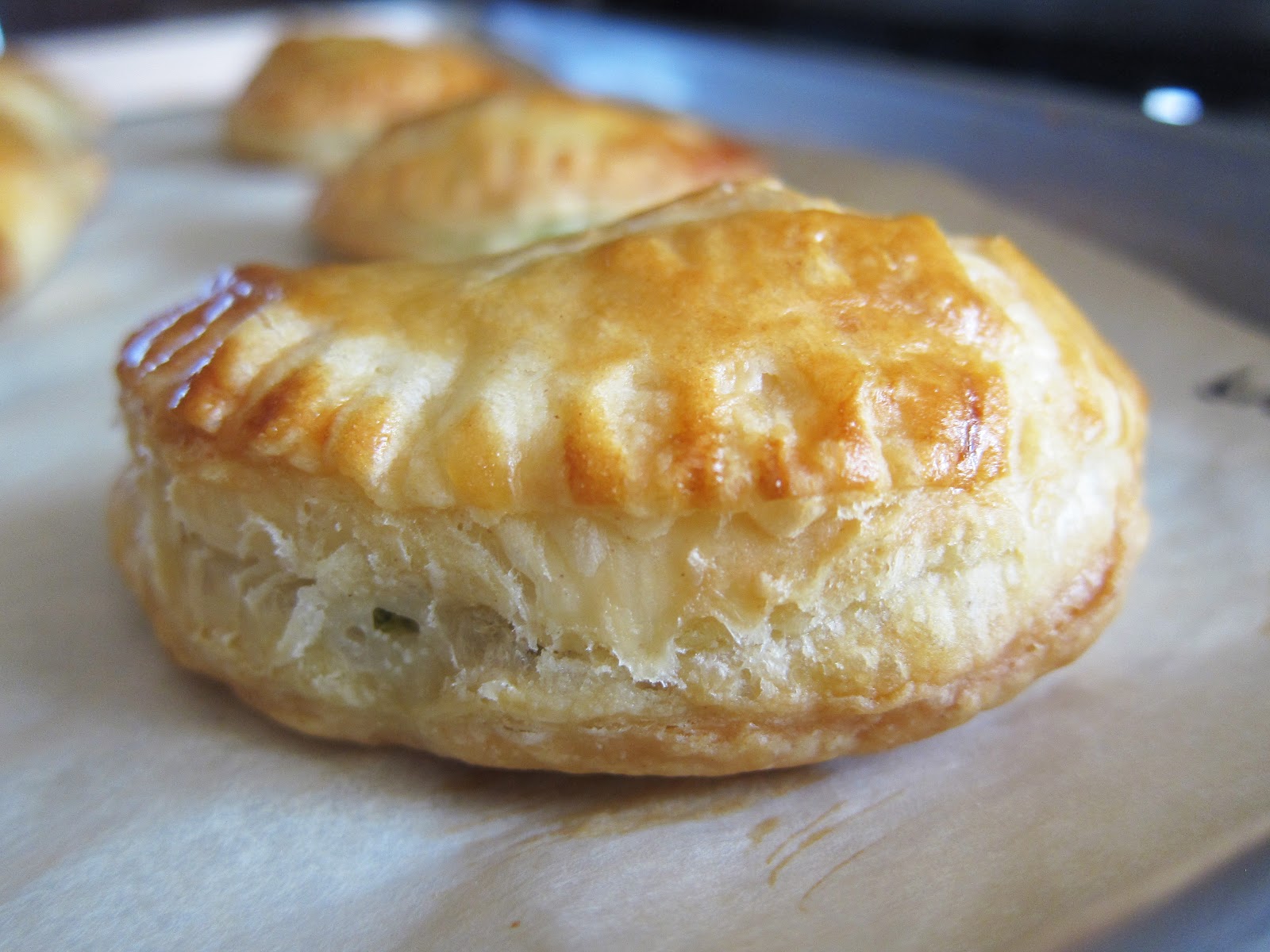
curry puff up close
.

Sunday, February 13, 2011

Palmiers

There's a bakery in Beach Haven, NJ (Crust & Crumb) that makes pastries called elephant ears. Each "ear" is about probably about 7 inches tall and 5 inches wide (at least that's my best guess based on my shotty childhood memory).

They taste nothing like an actual elephant's ear (not that I would know, I assure you). They're flaky and cinnamony and just thinking about them makes me feel like a kid on vacation (back when being on vacation really, truly meant having no responsibilities).

These palmiers are like a miniature version of elephant ears (except because they're so much smaller, they are a little crunchier). They're really cute (elegant even) and nice for Valentine's Day (they do look like little hearts).


PALMIERS

puff pastry dough (store-bought frozen or homemade)
granulated sugar*, mixed with ground cinnamon (2-3 teaspoons per cup)
water or beaten egg white for brushing

*The amount of sugar depends on how much puff pastry dough you're rolling (figure on about 1 cup per sheet).


1.   Roll dough out into a thin, large rectangle, about 14" x 12" (instead of using flour to roll, sprinkle very generously with cinnamon-sugar on the bottom and top as you roll).  Use a scant 1/2 cup sugar on each side (save a little for sprinkling later).
2.   Find the center and fold the dough (lengthwise) halfway to center.  Repeat with other side.  Roll each towards center with a little space down the middle.
3.   Brush with water or egg white and fold over on top of each other.  Lightly seal with rolling pin.  Rest for at least 1 hour in the refrigerator.
4.   Preheat oven to 375º F.  Trim the ends so they're not uneven. Slice the dough into 3/8" slices and spread out on parchment lined baking sheets, about 1 1/2" apart. Sprinkle cookies with cinnamon-sugar. Bake for about 8 minutes (bottom should be golden).  Flip cookies and bake until golden on both sides.

This recipe is based on notes I took as a student at the French Culinary Institute.
rolled dough
The rectangle doesn't have to be perfect, you can trim the ends later.
This rectangle is larger than 14" x 12" because I used homemade dough.
fold it in half to find the center
fold each edge in halfway towards the center
fold in again towards the center (leaving some space in the middle)
brush with water or egg white
fold together (gently tap with your rolling pin to help seal)
slice cookies (after dough has rested in fridge)
before baking (only a few have already been sprinkled with
cinnamon/sugar)...leave space between cookies for the puffing
puffed and golden

I probably would have chosen one of the above cookies for the closeup photo up top, but unfortunately I dropped the entire tray on the floor. Even with the three second rule applying, they were all broken and chipped (so no longer photo worthy). Luckily I had made two sheets. This is not an unusual occurrence in my kitchen, so if you have butter fingers too, you're not alone (and in my defense, these are very buttery)!

Saturday, February 12, 2011

Puff Pastry Dough (homemade)

turned dough (read on to find out what that means)
I know what you're thinking. Something along the lines of someone go get Meemaw's old straight jacket, she's finally gone off the deep end! It's okay, I realize most sane people won't make puff pastry when it's so easy to buy (I don't always do it, who's got that kind of time). And it's true, the store-bought works well enough, but it is made with oil (instead of butter) and even has a few other unnecessaries thrown in.

Plus there's something I love about the sheer magic of making puff pastry. Constructing well over a thousand layers (2,187 to be exact) just by folding the dough and increasing the layers exponentially (scroll down to see the math). It's pretty damn cool.


PUFF PASTRY DOUGH
Yield: approx. 2 lb.

500 g. all-purpose flour (approx. 3 1/2 cups)
75 g. unsalted butter, melted & cooled (approx. 5.3 tablespoons)
2 teaspoons salt
250-280 g. water (approx. 1 cup + 1 to 3 tablespoons)

500 g. cool butter (approx. 1 lb. + 3 tablespoons), not right from the fridge, but not too warm


1.      Combine flour, 75 g. butter, salt and water; mix only until thoroughly combined. 
2.      Form dough into ball. Cut an “X” in the top (helps dough relax and separates it into 4 quarters to help roll into the right shape).  Let rest in refrigerator for at least 1 hour.  This dough is called the “detrempe”.
3.      Sandwich the 500 g. cool butter in between 2 sheets of plastic wrap (shape as close to a square as possible). Flatten & soften by hitting with a rolling pin and shape into a square about 1 ¼” thick.  Wrap and keep cool (but still slightly softened).
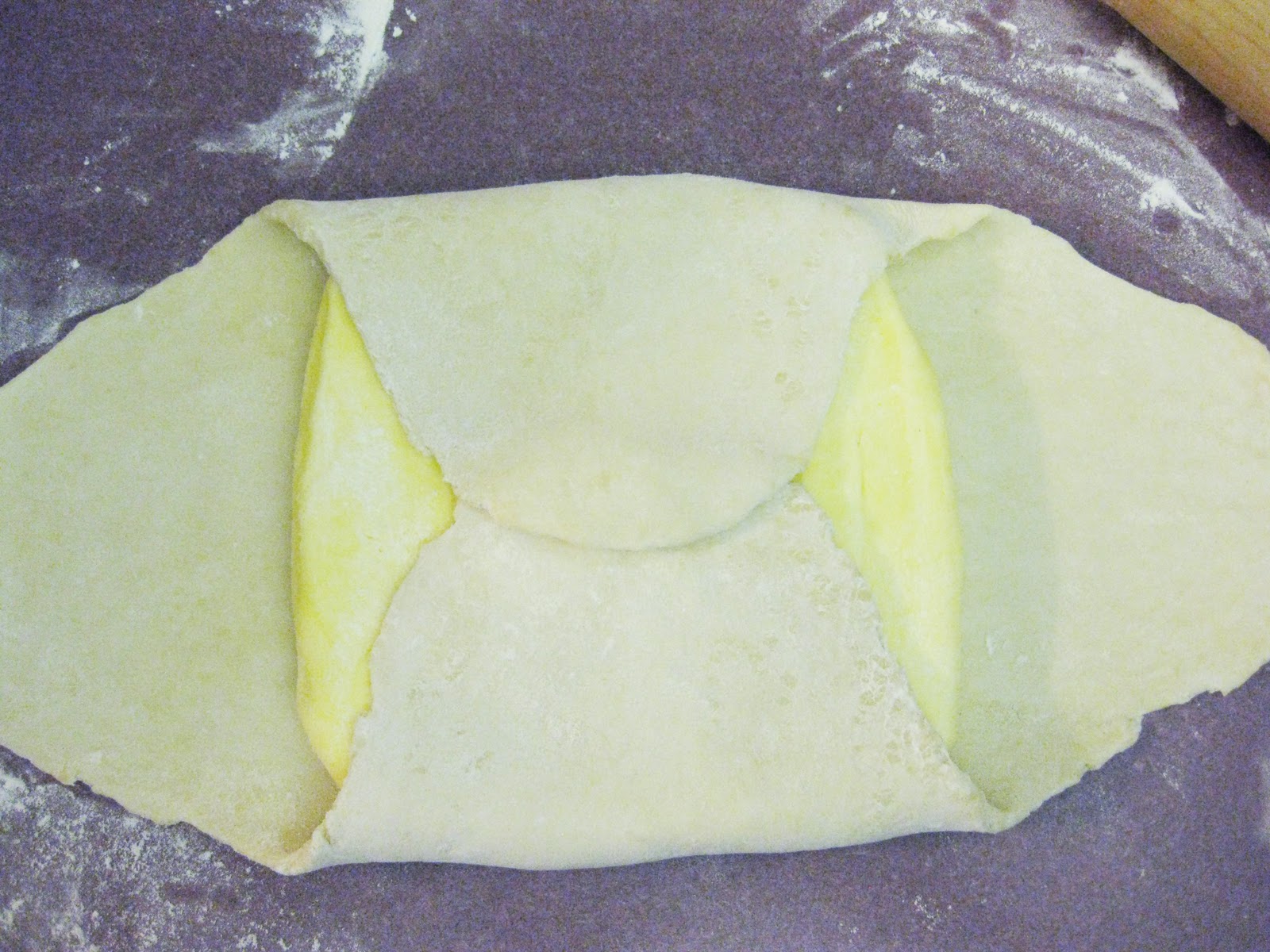
4.      Remove dough from fridge, roll “sides” out thinner than center.  Place butter in the center and fold corners over the butter like a package (called a “pâton”); seal well.  Roll out and fold to make 3 layers (this is called a "turn"; see the photo at the top of the page).  Make one more turn*; let rest for at least 1 hour in the refrigerator.
*After the first turn, give the pâton a 1/4 turn so the opening is to the right or left.  This is necessary before each rolling, so the gluten is stretched in all directions—not just lengthwise.  If not, the dough will shrink or bake unevenly.

5.      Roll and make 2 more turns; rest for at least 1 hour in the refrigerator.
6.      Roll and make final 2 turns; rest for at least 1 hour in the refrigerator.
7.      Roll, rest and use according to recipe. Can be refrigerated for 3-4 days or frozen for up to 2 months.

This recipe is adapted from a handout I received at the French Culinary Institute.
 
the detrempe  
butter before flattening

flattening 
flattened

rolled detrempe with butter on top
2 sides folded

3 sides folded
the pâton (no butter should be
peeking out)
rolling out the pâton

rolled and ready for the first turn
(it's okay if it's not a perfect rectangle)
the first fold of the first turn

the second fold of the first turn (now it's a complete turn and ready to roll for 1 more turn before resting)
Repeat turning and resting according to the recipe.

rolled and ready to use in whatever recipe you choose
(how thin you roll it will depend on what you're making with it)

Here's the math that gets you to ultimately reach 2,187 layers!

Layers
Pâton has 3 layers (dough, butter, dough)
after 1st turn:  3 x 3 = 9 layers
after 2nd turn: 3 x 9 = 27 layers
after 3rd turn:  3 x 27 = 81 layers
after 4th turn:  3 x 81 = 243 layers
after 5th turn:  3 x 243 = 729 layers
after 6th turn:  3 x 729 = 2,187 layers

The leavening happens 3 ways
Steam:  Moisture in the dough (water) and in the butter becomes steam, which pushes the layers apart, separating fat layers from the dough.
Enclosed/Trapped Air:  Each time the dough is folded, some air is trapped.  These air cells expand during baking and push layers up and apart.
Fat: When the butter is heated, air bubbles form and begin to boil, raising the layers.

Butter is the best fat to use, because of its flavor and melting point. Incorporate evenly throughout the dough. Too warm butter is more difficult to work with. A hot kitchen causes butter to melt too quickly. Too cold butter will puncture the dough. Best results are when the dough and butter are the same temperature and consistency.
raw puff pastry dough
baked puff pastry dough (amazing, right?)
cross section of the flaky layers

Some delicious things you can make with puff pastry: napoleons, turnovers, cheese sticks, palmiers, pies, tarts and an endless variety of hors d'oeuvres.

label from store bought puff pastry

Not so terrible, I've eaten way worse (don't even ask).
At least the monoglycerides and high-fructose corn syrup
are in the "2 percent or less" listing. But if it's a contest,
homemade wins (it usually does).


Saturday, February 5, 2011

Pear, Leek & Gruyère Turnovers

Since it's pear season (and they're so delectable right now), I really wanted to try something new with pears. I was delighted when I spotted this recipe because it had been so many years since I made turnovers. I knew it was meant to be. 

I'm pleased to report that I wasn't let down. These were a real treat. Warm, crispy, flaky, slightly gooey, savory and sweet, all at the same time. Definitely a home run. Even my 5-year-old loved them.


 PEAR, LEEK AND GRUYÈRE TURNOVERS
Yield: 8 turnovers

2 tablespoons unsalted butter
1 1/2 cups chopped leeks
1 (6- to 7-oz.) firm but ripe pear, peeled, cored and chopped
1 1/2 teaspoons sugar
3/4 cup (packed) grated gruyère cheese (about 3 oz.)
1 1/2 tablespoons chopped fresh chives
1 (17.3-oz.) package frozen puff pastry (2 sheets), thawed
1 egg, beaten to blend (for glaze)


1.      Melt butter in heavy large skillet over medium heat. Add leeks; stir 1 minute. Reduce heat to low; cover and cook until leeks begin to brown, stirring occasionally, about 7 minutes. Stir in pear and sugar. Increase heat to medium; sauté uncovered until any liquid evaporates, about 2 minutes. Season with salt and pepper. Transfer to bowl; cool. Stir in cheese and chives.
2.      Place puff pastry sheets on work surface. Using 4 1/2-inch-diameter tartlet-pan rim or bowl as aid, cut out 4 rounds from each pastry sheet. Roll out each pastry round to 5-inch circle. Place leek mixture on half of each pastry round, dividing equally. Brush pastry edges with egg glaze. Fold pastry over filling, pressing to adhere. Press edges with fork to seal. Brush turnovers with egg glaze. Pierce pastry in several places with toothpick. Place on baking sheet. Chill 20 minutes.
3.      Preheat oven to 400° F. Bake turnovers until puffed and golden, about 18 minutes. Serve warm.

Copyright Bon Appétit, March 2000
cooked leeks and pears
rolling out the puff pastry rounds (using frozen
puff pastry makes this recipe easier than it looks)
filling on top; brushing the edges with egg
sealed (or one could even say turned over)
crimping the edges
brushing with egg
already brushed, with holes poked
done!
closeup of the flaky layers

There are frozen puff pastry doughs out there made with real butter instead of oils (the way puff pastry was meant to be). They can often be found in gourmet or specialty shops. If you're lucky enough to have one nearby, check out the freezer section and see what you can find.